
Overview
The Online Amateur Radio Community Intermediate Training Course is a fast track online interactive course run over 6-8 weeks
Below is an overview of the program:
| Week | Summary |
| 1 | Course Overview & Licence Conditions |
| 2 | Electronics Part 1 – Measurements & Components |
| 3 | Electronics Part 2 – Further components & tuned circuits |
| 4 | Electronics Part 3 – Semiconductors & RF Oscillators |
| 5 | Transmitters & Receivers |
| 6 | Harmonics & Spurious Emissions, Antenna Matching |
| 7 | Antenna Concepts & Propagation, Safety |
| 8 | Exam Prep & Coaching |
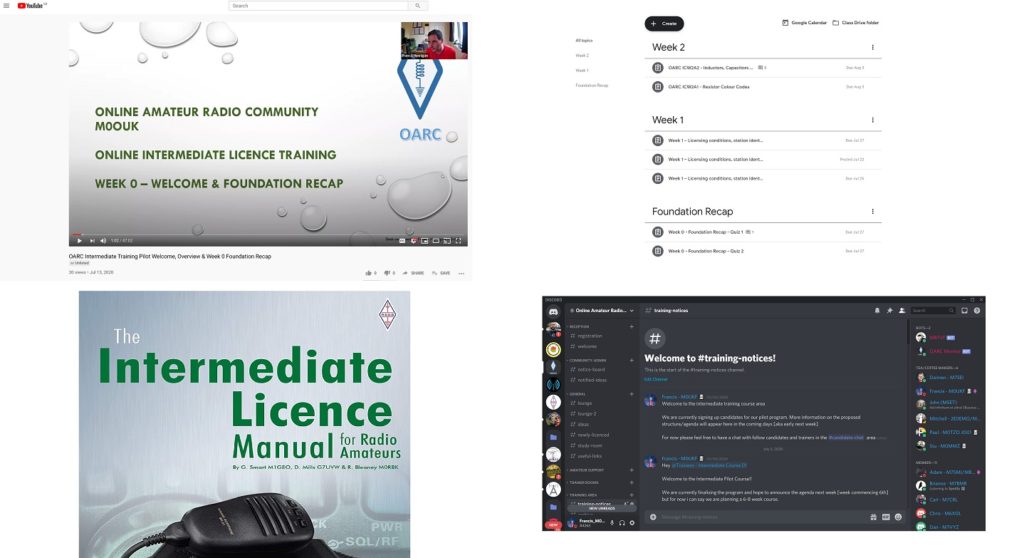
Each week you will be set a number of activities including:
- Taking part in a weekly Zoom session with fellow candidates, typically 1 – 1.5 hours on a Wednesday evening at 7:30pm [streams are available to candidates unable to attend – meeting days/times vary to try and maximise who can attend each week]
- A number of activities or quizzes on the weeks topics
- A weekly reading list of pages from your Intermediate Manual
- Additional support material, often in the form of YouTube videos, from a diverse range of sources
What is the cost?
Adults
£5 [All money is invested back in the community and used to cover delivery costs, such as Zoom, web hosting and community services.]
Students, Under 18s & Concessions
The course is free to under 18’s and those in full time education Concessions are available for those facing hardship.
Setting expectations
Everyone learns differently, some absorb books like a sponge, others really need that 1 on 1 time to get more complex concepts down. This course lands somewhere in the middle.
We have aimed at those who benefit from structured learning and having material presented in fresh and interesting ways, but also are able to hold themselves to account to complete tasks by specific dates.
But¦. you need to be aware this course is very intense!
Most club courses will run over around 12-14 weeks, this course is delivered in 7. It carries with it an assumption that you have, as a minimum, the foundation level of knowledge in recent memory, and that you passed your original exam with a comfortable margin in most sections.
So who is this course for?
This course is aimed at those who have recently obtained their foundation licence and are looking to take the next step. It’s targeted at those who are comfortable with modern communication methods, from Google Classroom, Zoom through to Discord & who are prepared to commit real time and effort to additional self study & revision throughout the week to rise up this learning curve & be ready for the next module.
Who is the course not suited to?
This course is not suited for those who have obtained their foundation licence over 12 months ago [unless you complete some form of study ahead of time]. Whilst one-on-one coaching is available if you struggle on certain concepts, there is not the bandwidth or time to provide one-on-one instruction. If you are not confident using tools such as Zoom, Discord and Google Forms without support then you will be unlikely to keep up with the pace that the course is run at.
How do I apply?
If you aren’t already a member of the OARC, Click Here or click the ‘Join Us’ link above to join our community discord. It’s free!
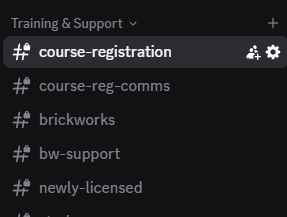
Once a member of the discord community, click on the #course-registration channel and follow the instructions.
Course Dates
All our course content focuses on the UK amateur radio licencing exams. Anyone may undertake our course and sit the UK amateur licence exam provided by the Radio Society of Great Britain but, a pass at any level will in itself only allow you to apply for a licence to operate in the UK.
If you progress to the full level, you will also be issued a Harmonised Amateur Radio Examination Certificate which can be used to obtain a licence in a number of countries. See https://docdb.cept.org/download/2569 for more information.
Some other administrations may also issue reciprocal licences if you hold a full UK licence.
Whichever approach you take, the work required to progress through to full is significant so you may wish to check agreements locally.